Artur Arsénio
Innovator | Manager | Engineer | Passionate for new technology business

Sponsor: FP7 European Research Project.

Jan. 2013 - March 2014
MONARCH: Multi-Robot Cognitive Systems Operating in Hospitals
The concept and design for the robotic shell were the result of work at YDreamsRobotics by David Gonçalves, under the scope of a Research Scholarship oriented by me. The final robot construction was the result of collaborative work between several project partners.
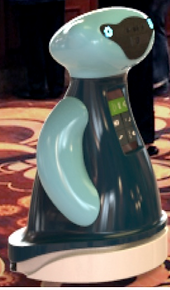
Robot: renderings of final design, and after production.
Robot renderings of final design, and robots after production.
-
Assembling the shell to the robots: as on SIGA and LINK robots - magnets
-
Incorporating soft touch feeling materials (robots t-shirt, personalization)
-
Definition of the internal supports that will secure the interaction equipment

 |  |
|---|---|
 |  |
 |
Final CAD designs in SolidWorks
CAD Designs
Design process
Shell Development Process
-
Operational Environment Analysis
-
Aesthetics
-
Functional Properties
-
Ergonomics And Human Factors
-
Concepts
-
Final Design
 |
|---|
 |
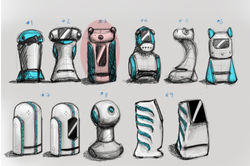
Head Formats And Emotional Expressions
Concepts
Human Factors

Problems from bad positioning and dimensioning of the robot components:
-
a non-threatening overall stance;
-
arms placed in a peaceful resting position, expecting feedback from humans;
-
upward face maximizes viewing angles, reinforces feedback expectation feelings;
-
touch screen placed higher on the body, reachable and viewable by adults and kids at a specific angle.
Children: robots should have a modern and cool appearance.
Hospital: lighter colors; easier to identify and clean dirty surfaces on the robot.
Comfort zone: interaction space where child feels confortable without feeling anxiety or risk is very large
Visual Interactions
-
LEDs overall body emotional expressions LEDS face
-
virtual content (projected or displayed on screen)
-
Face identification & tracking,
-
Human gesture model,
-
fiduciary markers recognition
Tactile Interactions
-
touch screen (as a natural user interface for easy data insertion by children and other humans)
-
capacitive sensors for human-robot contact.
Motion Interactions
-
robots convey information through an appropriate set of arms, head, and body motions.
Human-Robot Interactions
Sound Interactions
-
convey information to children concerning new activities, danger or alert signals, communication sounds, emotive sounds or speech.
-
Microphone array (Sound processing, Speech recognition using Microsoft Speech Recog. SDK)
Dynamic Interactions
-
Action/reaction movements
-
interaction dynamics,
-
initial and final position for movements, as well as resting position.
“Invisible" Interactions
-
RFID Reader: to identify the interacting children.
Features to Apply:
-
Rounded shapes: in the target hospital environment, the pediatric ward, children spend often long recovery times, and hence it is common to find them running and playing around the space. Therefore, due to the danger of children falling, the robot shell should consist of rounded shapes. Furthermore, in the robot body regions whether the children might try to step in, the roundness should guarantee that children are not able to ride on top of the robots.
-
Big head relative to body size: Several studies have shown that humans are more attracted by big heads. Indeed, evidence demonstrates that this seems to be an evolutionary feature that triggers parents protective behaviours concerning newborns (which have bigger head proportions compared to a normal adult). This is therefore a desirable feature in order for robots to be more appealing, and likable, not only to children, but also to adults with whom robots must also interact with on the pediatric ward.
-
Soft touch feeling materials: the mobile robots will be equipped with different touch interaction sensors, namely capacitive sensors on the body and head, as well as a tablet on the body with a touch screen. Additionally, the children are supposed to be able to touch the robots, and as such instead of rough materials (for instance, metal-like materials), it is desirable either to use soft materials (e.g. rubber, cork) as the shell material, or else dressing the shell with such material (for instance, dressing robots with a t-shirt of a soft material.
-
Textured surfaces: children toys are usually highly textured, having the dual goal of attracting children attention and providing more cognitive stimulation uppon touching. With this goal in mind, a combination of neutral and active colors should also be employed.
-
Dynamic stance: as robots are to be deployed moving around on a ward whether children are in constant movement, it is important to convey a dynamic stance to their appearance
Features to Avoid:
-
Mechanical type shapes: mechanical type shapes are more aggressive, and possibly scaring for children.
-
Exposed components: components salient from the robot body are potentially dangerous for any child, and can also inspire fear on them.
-
Generic and lifeless body outline: robots outfit should inspire children for interacting with them.
Environment
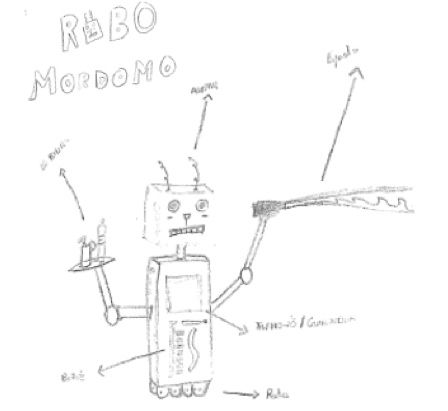
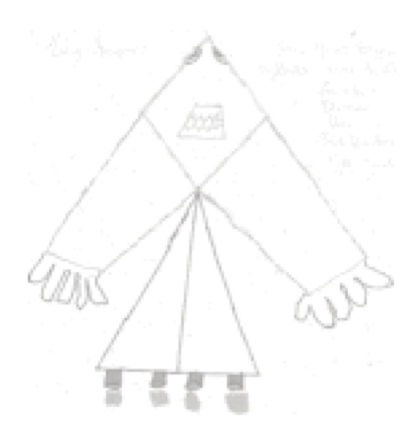
Children's Drawings

 |  |
|---|---|
 |
 |  |
|---|---|
 |  |